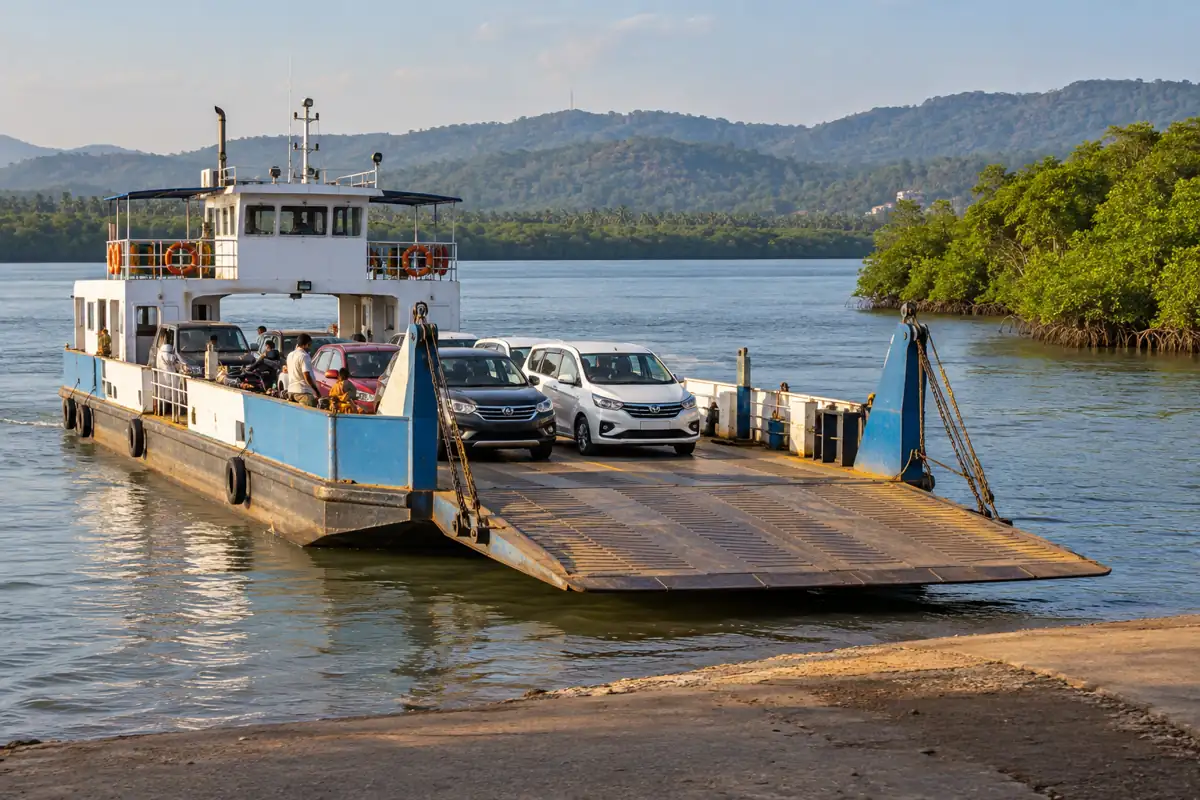
The Virar–Saphale (Jalsar) ferry provides a water connection across the Vaitarna River area. Its usefulness depends on where you start and where you need to finish: a waterfront crossing can suit a local vehicle journey, while a rail passenger must still account for transport between the station and jetty. “Virar to Saphale” should not be read as a station-to-station transfer.
The tables below transcribe the supplied operator notices. The timetable is dated 20 April 2025, with its night-service section marked to start from 25 April 2025. The rate card is effective from 21 April 2025. They are published reference notices; check the official Virar–Saphale (Jalsar) route page and current jetty announcements before relying on a particular sailing or price.
Understand the two landing points first
The operator markets the service under Virar and Saphale, with Jalsar identifying the landing on the Saphale side. Local reporting describes the Virar end around Marambalpada or Narangi. Those names matter when asking for the final road connection. A map search for Saphale railway station alone will not identify the ferry landing.
This is a roll-on, roll-off route, reflected in a fare card with motorcycles, cars, commercial vehicles and passenger categories. It can carry a different kind of journey from a railway trip: you may arrive with your own vehicle and continue on local roads after landing. Before deciding, compare the distance to the jetty, the likely queue and the onward road, rather than only the water crossing.
Ferry Time Table
Each time is a departure from the named side. Read the Virar column for an outward journey from Virar and the Saphale (Jalsar) column when boarding at Jalsar. The headings “Morning”, “Afternoon” and “Night” reproduce the groupings on the supplied notice; they do not imply a promise of continuous service between those times.
| Published section | From Virar | From Saphale (Jalsar) |
|---|---|---|
| Morning | 6:30 AM | 6:45 AM |
| Morning | 7:30 AM | 7:45 AM |
| Morning | 8:15 AM | 8:30 AM |
| Morning | 9:00 AM | 9:15 AM |
| Morning | 9:45 AM | 10:00 AM |
| Morning | 10:30 AM | 10:45 AM |
| Morning | 11:15 AM | 11:30 AM |
| Afternoon | 12:00 PM | 12:15 PM |
| Afternoon | 12:40 PM | 12:50 PM |
| Afternoon | 1:35 PM | 1:45 PM |
| Afternoon | 2:15 PM | 2:30 PM |
| Afternoon | 3:00 PM | 3:15 PM |
| Afternoon | 3:45 PM | 4:00 PM |
| Afternoon | 4:30 PM | 4:45 PM |
| Afternoon | 5:15 PM | 5:30 PM |
| Afternoon | 6:00 PM | 6:15 PM |
| Afternoon | 6:45 PM | 7:00 PM |
| Night | 7:30 PM | 7:45 PM |
| Night | 8:15 PM | 8:30 PM |
| Night | 9:00 PM | 9:15 PM |
| Night | 10:00 PM | 10:10 PM |
Keep the listed irregular times as printed: 12:40 PM, 1:35 PM and the final 10:10 PM departure are not rounding errors to replace with a regular interval. Some paired departures are ten minutes apart and others fifteen. They belong to opposite sides of the route, so the gap between columns is not proof of the exact crossing duration.
Ferry Rate Card
The following amounts are from the supplied card dated 21 April 2025. Marathi category names have been translated into English. Base fare and tax are kept separate so readers can see how the total is formed. These categories are specific to this card: do not substitute the Vasai–Bhayander prices, even when the vehicle description sounds similar.
| Vehicle / passenger category | Base fare (₹) | Tax (₹) | Total fare (₹) |
|---|---|---|---|
| Bicycle | 9 | 1 | 10 |
| Motorcycle, including rider | 60 | 6 | 66 |
| Empty three-wheel rickshaw, including driver | 100 | 10 | 110 |
| Empty car (5 seats), including driver (e.g. Maruti 800) | 180 | 20 | 200 |
| Empty passenger vehicle (8 seats, e.g. Swift/Ertiga), including driver; empty medium goods vehicle (e.g. Tata 407) | 100 | 20 | 120 |
| Empty six-wheel medium goods vehicle, with driver and helper (e.g. Tata 709/Eicher 2015) | 250 | 25 | 275 |
| Empty passenger bus, truck or tanker, with driver and two helpers | 300 | 30 | 330 |
| Empty ten-wheel goods truck or JCB, with driver and two helpers | 500 | 50 | 550 |
| Goods, per half tonne | 27 | 3 | 30 |
| Goat, sheep or lamb (per four); dog, rabbit or cat (per animal) | 36 | 4 | 40 |
| Cow, bull or buffalo (per animal) | 50 | 5 | 55 |
| Adult passenger (above 12 years) | 27 | 3 | 30 |
| Child passenger (3–12 years) | 23 | 2 | 25 |
The ₹120 category on the notice combines an empty eight-seat passenger vehicle, with examples including Swift and Ertiga, and an empty medium goods vehicle such as Tata 407. The separate five-seat car category totals ₹200. These are the notice’s categories, not a recommendation to relabel a car by model. Ask the ticket counter which row applies to your actual vehicle and occupants.
Jetty addresses and directly visible maps
The addresses here identify terminal localities rather than a numbered street entrance. The embedded maps search for the ferry names and localities; match the selected result with the active terminal before travelling. A company office address elsewhere in Maharashtra is not the departure point for this crossing.
Virar side
Address / locality: Marambalpada / Narangi waterfront area, Virar, Maharashtra
Saphale side
Address / locality: Jalsar waterfront, Saphale side, Palghar district, Maharashtra
Journey time: the crossing is only one part
The operator describes the water crossing as around fifteen minutes. Treat that as its advertised crossing estimate, not a guarantee of a complete journey from central Virar to central Saphale. Loading, waiting and disembarking happen around the crossing. The time saved by one traveller may disappear for another whose start or destination is far from a landing.
Compare two complete plans on paper. For the ferry, include the approach road, waiting allowance, crossing and onward connection. For the alternative, include its actual start and finish points as well. This makes the comparison fair. If you are travelling for an appointment, build a margin around it; if you are sightseeing, preserve enough daylight and a comfortable return option.
Getting to Virar and continuing from Jalsar
When arriving from another part of the region, use the Vasai arrival guide for the wider travel context and then plan the Virar terminal connection separately. Confirm the active approach with your local transport provider. For a first crossing, avoid assuming that a map’s shortest line is a suitable vehicle road or that every waterfront track leads to the loading ramp.
On the Jalsar side, decide where you will go before buying a ticket. If travelling on foot, work out how you will reach the village or onward transport and how you will return to the landing. With a car or motorcycle, allow time to rejoin the road after unloading. A map helps with orientation, but it does not confirm transport availability at your chosen arrival hour.
Tickets, extra passengers and commercial loads
Start with the vehicle category and read what the card includes. A motorcycle fare explicitly includes its rider; several large-vehicle categories include a driver and named helpers. Extra occupants may need separate tickets. Ask the counter rather than adding or removing passenger charges by guesswork. Request a clear total for your group and retain the ticket for the trip.
For commercial travel, the distinction between an empty vehicle and goods is important. The card has a separate charge per half tonne of goods, but it does not explain every combination or operational restriction. Describe your vehicle and load accurately before queuing. Confirm whether the vehicle can be accepted on that sailing, and follow the staff’s positioning instructions on the approach and deck.
Board safely and keep the landing area clear
Wait outside the working ramp area until staff direct you forward. Keep children beside an adult and keep bags under control. If you need assistance with steps, a wheelchair or a stroller, ask about the current vessel and landing arrangement before purchasing travel. A roll-on vehicle facility does not establish that every passenger route is step-free in every condition.
Follow the crew’s directions on passenger seating, life jackets and movement during the crossing. Avoid walking between vehicles while loading is under way. Photography should never take priority over boarding instructions or other people’s access to the ramp. Wind and rain can make handling loose bags or umbrellas awkward, so pack in a way that leaves you able to move steadily.
Use the ferry as one part of a manageable outing
A crossing can be a pleasant part of a day out, but it should not dictate an overloaded itinerary. The family day-out guide offers a useful way to think about shorter outings and breaks. Choose activities according to your group’s energy and your return transport, particularly if children or older relatives are travelling.
If your wider plan includes a Virar religious visit, the Jivdani Temple guide is a separate planning reference; the temple visit and ferry approach are not interchangeable locations. For a longer local weekend, the Vasai weekend itinerary can help you avoid squeezing every stop into the crossing day. Keep time for meals and local journeys instead of measuring the outing only by sailings.
Return planning and service changes
Before leaving the terminal, note which departure column applies to your return and check for a newer posted notice. An outward crossing does not guarantee space or operation on the last listed return. Conditions, queues or an operational interruption can change a plan. Keep an alternative land journey available and decide in advance when you would switch to it rather than waiting indefinitely.
Use this article to understand the dated timetable and fare structure, then use the operator’s current information for the day you travel. That distinction is especially important for evening journeys. A successful ferry trip is one where the landing, ticket category and return all make sense for your group, not merely one where the advertised crossing time sounds attractive.